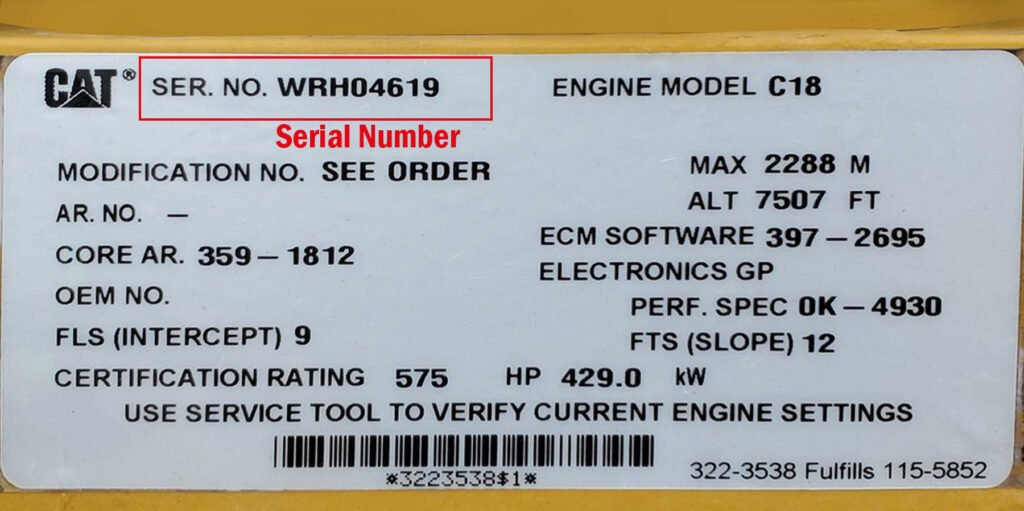
Most wrong-part deliveries start the same way. Someone calls a supplier, says they need a water pump for a 320D, and both parties assume that is enough information. It usually is not. Caterpillar changed component specifications mid-production on plenty of models, so two machines with the same model badge can take different parts.
Getting the number right before you order saves a return, a second delivery and several days of downtime. Here is how to do it.
Start with the serial number, not the model
The model number tells you very little. The serial number tells you everything, because Caterpillar builds parts compatibility around serial ranges.
On most machines the serial plate sits in one of these places:
- Excavators: on the right side of the upper frame near the cab, or inside the cab on the door pillar
- Wheel loaders: on the right side of the front frame, or on the rear frame near the articulation joint
- Dozers: on the right side of the main frame, usually near the operator station
- Generator sets: on the engine block or the control panel housing
If the plate has rusted or been painted over, the serial is usually stamped into the frame close to where the plate sits. A wire brush and some patience will normally bring it up. Our equipment page shows the machine types we most commonly supply parts for, which can help if you are unsure what family your machine belongs to.
Reading the serial number
A CAT serial number is typically 17 characters on newer machines (the PIN) or 8 characters on older ones. The first three characters are the prefix, and they identify the model variant. This is the part people skip.
Two machines both badged 320D can carry different prefixes, which means different hydraulic pump part numbers, different control valves and different wiring. The prefix is the difference between a part that bolts on and a part that sits in your workshop waiting to be returned.
Find the number on the old part first
The fastest route is usually the part already in the machine. Most CAT components carry the part number cast, stamped or printed on the body. Clean the surface, look on the flat faces and the mounting flanges, and photograph whatever you find before removing anything.
Photograph it even if the number looks clear. Numbers get smudged, light catches them badly, and a photo lets your supplier verify what you read rather than taking your word for it.
Where the number sits varies by component type. On engine parts it is usually cast into the body. On electrical components it is more often on a printed label, which means it can wear off entirely — in that case you will be working from the serial number instead.
Superseded numbers
Caterpillar retires part numbers regularly and replaces them with updated versions. The old number still exists in the system but points to a new one. Sometimes the replacement supersedes twice or three times before you reach the current part.
This catches people out when they order against a number from a service manual printed years ago. The number is not wrong exactly, but it is not current either. Any supplier with proper system access can trace the chain for you. If they tell you a number does not exist, ask them to check for supersession before you assume the part is discontinued.
Where the number appears if you do not have the part
- Parts manual for your machine, cross-referenced against your serial range
- Service records from previous repairs, which often list numbers that were already verified
- The machine’s own parts book, if the previous owner left it in the cab
- A supplier who can look it up from your serial number. If you already know roughly what you need, browsing the full parts catalogue will often get you to the right component family faster than a manual will
Mistakes that cost the most time
Ordering by model name alone
Covered above, but it is the single most common cause of wrong deliveries, so it bears repeating. The serial number takes thirty seconds to find and removes nearly all of the risk.
Reading 8 as B, or 0 as O
Stamped numbers on dirty castings are genuinely hard to read. If a number comes back as not found, try the common substitutions before concluding it does not exist.
Assuming a kit number is a part number
Seal and gasket kits carry their own numbers that do not match any individual component inside them. Ordering a kit number when you need one seal means paying for twenty parts you do not need. The reverse happens too — people order a single gasket when the job really needs the full kit.
Trusting a number from a marketplace listing
Listings on general marketplaces are frequently mislabelled, sometimes deliberately. Verify against the machine or a parts manual rather than against someone else’s advert.
Consumables are the exception
Filters are the one category where you can often order confidently from the machine model alone, because CAT filters are usually shared across a wider range of machines than mechanical components are. Even so, confirm against the serial number if the machine is near a model year boundary. Getting an oil filter wrong is cheap; getting a hydraulic filter wrong and running the system unfiltered is not.
What to send a supplier
If you want a quote back the same day, send all of this at once:
- Machine model and full serial number or PIN
- Part number from the old component, if you have it
- A photograph of the part, including any visible markings
- What the part does on the machine, in plain description, in case the number turns out to be wrong
That last item matters more than people expect. If the number is misread, a description gives the supplier something to work from instead of sending you back to the machine. Send us those details and we will confirm the part number, availability and fitment before you commit to anything.
Related reading
If you are identifying parts because something has failed rather than for routine service, two other guides may help: measuring undercarriage wear covers track chains, sprockets and idlers, and deciding between an engine rebuild and a replacement covers what to check before committing to either.
Frequently asked questions
Where is the serial number on a CAT excavator?
Usually on the right side of the upper frame near the cab, or inside the cab on the door pillar. On older machines it may be stamped directly into the frame rather than on a plate.
What does the prefix in a CAT serial number mean?
The first three characters identify the model variant. Two machines with the same model name can have different prefixes, and parts compatibility often follows the prefix rather than the model.
My part number comes back as not found. What now?
Check for supersession first, since Caterpillar retires and replaces numbers regularly. After that, check for misread characters, particularly 8 against B and 0 against O.
Can I order without a part number?
Yes. Send your machine model, serial number and a photo of the component. A supplier with system access can identify the part from that.
Do aftermarket parts use the same numbers?
Most quality aftermarket manufacturers cross-reference to the original CAT number so you can match them directly. Confirm the cross-reference with your supplier rather than assuming it.